The Hidden Fire Hazard in Your Yuba City Backyard
Professional junk-removal in Yuba City. Boxpro Express offers same-day service and free estimates. Call (530) 978-8081.
The Hidden Fire Hazard in Your Yuba City Backyard: A Homeowner’s Guide to Savvy Safety
Yuba City is a place of profound beauty—where the Sacramento Valley’s golden horizons meet the Sierra Nevada foothills, and neighborhoods like the historic downtown, Linda, and the verdant areas along the Feather River offer a lifestyle many dream of. We cherish our backyards here: the shade of an old oak, the scent of citrus in bloom, the quiet patio for evening relaxation. But lurking within that cherished space can be a silent, accelerant threat, uniquely amplified by our Central Valley climate. The hidden fire hazard in your Yuba City backyard isn’t a dramatic, obvious danger; it’s a cumulative collection of seemingly innocuous items and overlooked conditions that, in the dry heat of a July afternoon or during a windy “Delta breeze” event, can become the fuel for disaster.
True luxury in homeownership isn’t just about aesthetics; it’s about profound, intelligent stewardship. It’s understanding the specific ecological and regulatory context of Yuba City and transforming your outdoor space from a potential liability into a curated, defensible sanctuary. Let’s move beyond generic checklists and delve into the granular, actionable intelligence every savvy Yuba City homeowner needs.
H2: The Overgrown Vegetation Menace: More Than Just “Messy”
Our Mediterranean climate of hot, arid summers and mild, wet winters creates a perfect cycle for fire fuel accumulation. What might look like a lush, private thicket is, in fire science terms, a “fuel ladder” waiting to happen.
H3: Drought-Stressed Plants and “Fire Ladders”
Yuba City’s watering restrictions and periods of severe drought, like those experienced in recent years, stress native and ornamental plantings. Stressed plants die back, creating fine, dry fuels—dead leaves, branches, and brittle stalks—that ignite with terrifying ease. The critical concept here is “ladder fuel.” This occurs when vegetation of varying heights—low ground cover, shrubs, and the lower branches of trees—creates a continuous vertical path for fire to climb from the ground into the tree canopy. In older Yuba City neighborhoods where we have mature oaks or pines, a loquat shrub growing directly beneath the tree, or unchecked ivy climbing the trunk, is a direct conduit for fire to crown. The solution is deliberate spacing and pruning. Maintain a minimum of 10 feet of clearance between the crowns of trees and from tree canopies to your home’s roof or eaves. For shrubs under trees, keep them pruned low and remove any that have died back completely.
H3: The “Leaf Litter” Liability and Yard Waste合规性
That layer of fallen leaves, pine needles, and spent blooms is not mulching itself; it’s amassing a fine, combustible bed. In Yuba City, the Yuba City Fire Department’s Defensible Space guidelines are explicit: within the first 30 feet of your home (Zone 1), all dead and dying vegetation, pine needles, and leaf litter must be regularly removed. This isn’t just advice; it’s a cornerstone of local fire prevention policy. Beyond the 30-foot perimeter (Zone 2), while some residue can remain for habitat, it still needs to be managed to prevent a “fuel bed” from forming. The key is *regularity*. Don’t wait for autumn; utilize the city’s seasonal bulk green waste pickup schedules for the heavy material, and for the constant accumulation, a professional lawn care service with haul-away capabilities is a strategic investment in risk mitigation.
H2: Wooden Structures & Debris Piles: The Accumulated Tinderbox
The remnants of projects past and abandoned intentions are classic backyard clutter that doubles as fire tinder.
H3: Piles of Lumber, Pallets, and “Future Project” Materials
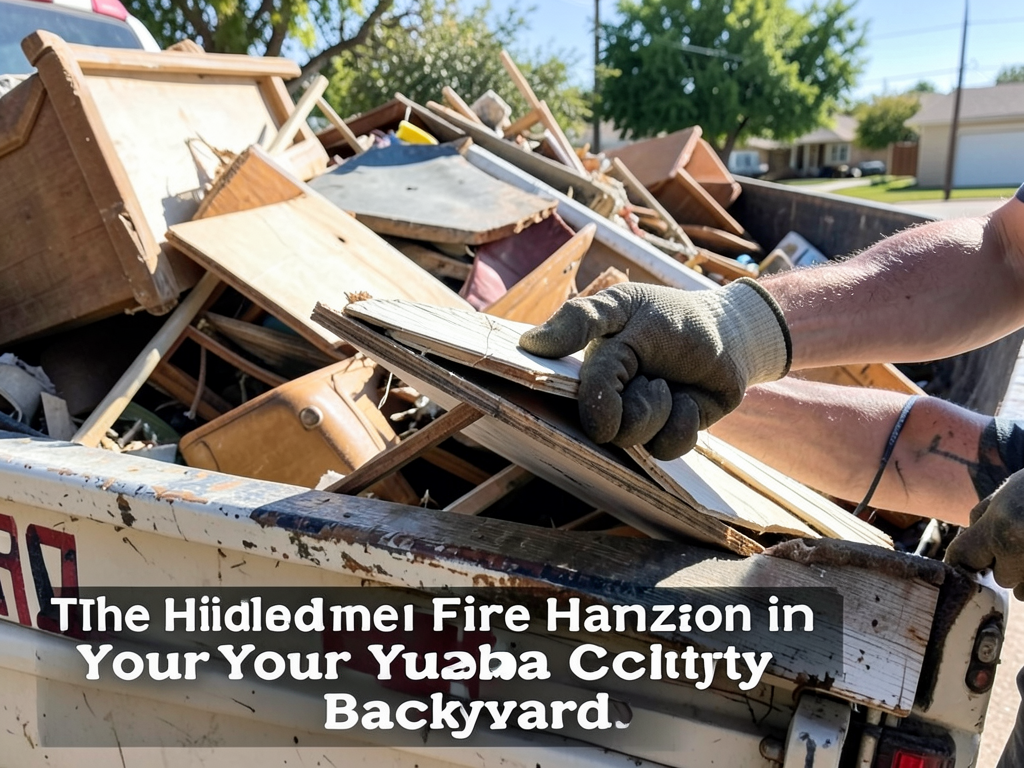
That stack of old fence boards leaning against the shed, the broken pallets from last year’s garden supply delivery, the lumber left over from a deck rebuild—these are prime, dry fuel. Treated lumber, while somewhat resistant to rot, can still burn fiercely and releases toxic fumes. The solution is immediate removal or, for usable material, storage in a fire-resistant enclosure or a detached garage *away* from your main structure and vegetation. Do not store any combustible materials beneath decks or against the sides of your home.
H3: Stump Remnants, Brush Piles, and “Natural” Habitat
A stump left to rot in the corner of the lot or a deliberate brush pile for “wildlife” is a significant hazard. These piles dry out internally, creating a smoldering risk that can reignite days after a spark lands. Given Yuba City’s proximity to agricultural land and natural riparian zones, the risk of ember cast from a nearby grass fire or a discarded cigarette is not theoretical. The only safe approach is complete removal of stump grindings and debris piles. A professional service with the right equipment—a stump grinder and a hauler with a dump truck capacity—is the only efficient way to handle this, ensuring the material is taken to the appropriate disposal facility, not just hidden.
H2: Flammable Liquids & Equipment: The Ignition Catalysts
The tools and toys that make yard work and recreation possible can become accelerants if stored carelessly.
H3: Propane Tanks, Gasoline, and Chemicals
That 20-lb propane tank for the BBQ, the gas can for the edger, and the half-empty cans of paint thinner and pesticides belong nowhere in your backyard. In summer heat, pressure builds in tanks and vapors from gasoline can ignite from a mere spark. Yuba City Municipal Code has strict storage regulations for flammable materials. All tanks and cans must be stored in a cool, well-ventilated area, *far* from your home and any ignition source—typically in a locked metal cabinet in a detached garage or shed. Never store them on a patio, under a stairwell, or inside your home’s attached garage. If a tank is old, rusty, or damaged, disposal is not a matter of curbside pickup; it requires special handling at facilities equipped for hazardous materials.
H3: The BBQ and Fire Pit: Controlled Fires, Uncontrolled Risks
Our love for outdoor grilling and evening fire pits is a beloved Yuba City tradition. But these are open flame devices. A BBQ left with greasy drip pans, a fire pit with insufficient clearances to overhanging limbs or dry decking, or a spark from a popping log can easily launch an ember into adjacent fuels. Maintain at least a 10-foot clearance radius around all grills and fire pits from any combustible material—including wood fences, pergolas, and dry vegetation. Have a water source (a charged hose) or a fire extinguisher rated for Class A (ordinary combustibles) and Class B (flammable liquids) fires immediately at hand. Never leave a burning fire pit unattended, and ensure it is completely cold before disposing of ashes in a metal container with a lid, on a non-combustible surface, for at least 48 hours.
H2: The Ignition Sources You Overlook: From Power to Pet Waste
H3: Outdoor Electrical and “Temporary” Power
Extension cords for holiday lights, landscape lighting transformers left on the ground, or a temporary power box for a pool pump can overheat, especially if damaged by UV exposure or rodents. All outdoor electrical must be rated for outdoor use (look for “UF” or “W” designation), elevated off the ground where possible, and inspected annually for cracks or fraying. Ensure your GFCI (Ground Fault Circuit Interrupter) outlets are functional—a critical safety device in damp conditions.
H3: The Non-Obvious: Glass, Metal, and Even Pet Waste
It’s a lesser-known fact that glass bottles or pieces of broken glass can focus sunlight and ignite dry tinder beneath them—a phenomenon known as “concentrated solar ignition.” Scan your yard for any debris that could act as a lens. Even large, dark-colored metal objects can get hot enough in our scorching sun to smolder dry organic material underneath. Finally, while it may seem unrelated, large accumulations of pet waste in a dry state are also combustible organic material. Regular removal is part of a comprehensive hygiene and safety plan.
H2: Professional Intervention: When DIY Isn’t Just Convenience, It’s Prudence
You can rake leaves all weekend, but certain hazards demand professional scope, equipment, and local knowledge. This is where strategic partnership elevates your home care from chore to sophisticated risk management.
H3: Hazardous Material Disposal & Regulatory Navigation
Disposing of old pressure-treated wood, painted lumber (potential lead), or chemically treated fence posts isn’t as simple as loading the truck. These materials have specific, regulated disposal channels to prevent environmental contamination. Professionals like Boxpro Express understand the Yuba-Sutter Landfill’s strict acceptance criteria and fees for various materials. They ensure your hazardous debris is diverted to the correct facilities, keeping you compliant with local and state environmental codes. Similarly, the sheer volume of overgrowth from a neglected lot often exceeds what city green waste programs will accept in a single pickup. A professional hauling service with a large-capacity trailer can clear an entire overgrown parcel in one visit, a logistical impossibility for the homeowner.
H3: Large-Scale Lot Clearing and Defensible Space Creation
Creating true, effective defensible space around a property with dense, mature landscaping or an overgrown acre+ lot is a major undertaking. It involves:
1. Assessment: Identifying which plants to save (fire-resistant, well-spaced) and which to remove.
2. Selective Removal: Using chainsaws, brush hogs, and limbing saws to strategically remove fuel ladders and thin canopies.
3. Root-Level Resolution: Grinding stumps to prevent resprouting and remove hidden flammable material.
4. Complete Haul-Away: Ensuring 100% of the slash, trimmings, and debris leave the property.
This is not a weekend project. It’s a multi-day operation requiring protection, specialized machinery, and a network for responsible disposal—resources a dedicated, locally-owned service like Boxpro Express brings to every job.
Conclusion: Curating Safety as Part of Your Yuba City Legacy
Your backyard is an extension of your home’s living space, a personal oasis in the heart of Yuba City. Protecting it from fire is an ongoing act of curation, blending aesthetic desire with rigorous, science-based safety. The steps are clear: conduct a critical, honest audit of your property’s fuel loads; adhere to the City’s defensible space guidelines with disciplined maintenance; and recognize the threshold where a job exceeds personal capability and becomes a professional responsibility.
Do not wait for a red flag warning or for smoke to appear on the horizon. Proactive clearance is the single most effective action you can take. The cost of professional intervention is an investment in the priceless security of your home, your family’s safety, and the preservation of your Yuba City property value.
Ready to transform your backyard from a hidden hazard into a truly safe, luxurious retreat? Boxpro Express provides the expert, comprehensive hauling and land clearing services Yuba City homeowners trust. We handle the heavy lifting, the regulatory complexity, and the responsible disposal, so you can enjoy your outdoor space with absolute peace of mind. Call for a detailed assessment and quote today at (530) 978-8081.
Ready to Build in Yuba City? Design Online or Talk with Jessica.
Lock in your transparent ballpark price in 60 seconds with our interactive 3D configurator, or talk live with Jessica, our project concierge, for instant answers and next Sunday measurement walk reservations.